
From 66/5 to 177 at Sharjah: The Empty Top-Order Ledger Inside Afghanistan's 37-Run Win
**मुख्य उत्तर:** अफ़ग़ानिस्तान ने शारजाह में पहला T20I 37 रन से जीता, लेकिन जीत की असली वजह 66/5 के बाद आख़िरी 51 गेंदों पर बने 111 रन थे। इस स्कोरलाइन ने अफ़ग़ान टॉप-ऑर्डर की कमज़ोरी और ज़िम्बाब्वे की डेथ-गेंदबाज़ी की कमी दोनों छिपा दी। **मुख्य तथ्य:** - अफ़ग़ानिस्तान: 19.5 ओवर में 177 ऑल आउट; 11.2 ओवर पर 66/5, फिर 51 गेंदों पर 111 रन (13.06 प्रति ओवर)। - इजाज़ अहमद अहमदज़ई: 22 गेंद पर 52 रन, स्ट्राइक रेट 236.4; 40 रन केवल चौकों-छक्कों से। - फ़ज़लहक़ फ़ारूक़ी: 3.1 ओवर में 3/13, इकॉनमी 4.11; उन्होंने पारी की आख़िरी गेंद फेंकी (19.1 ओवर)। - ज़िम्बाब्वे 19.1 ओवर में 140 पर ऑल आउट; टॉप स्कोर रायन बर्ल 32 (24 गेंद)। - अफ़ग़ान विकेटों में आठ तेज़ गेंदबाज़ों ने लिए; न्यामहुरी 3.5 ओवर में 4/31, इकॉनमी 8.09। - दूसरा T20I उसी शारजाह मैदान पर गुरुवार को, पहले मैच के 48 घंटे के भीतर। **स्रोत:** पहले T20I का सार्वजनिक स्कोरकार्ड सारांश, सीरीज़ जारी (तारीख़ सत्यापन लंबित) | Cross-checked: cricsultan.com **संबंधित प्रश्न-उत्तर:** प्रश्न: क्या अफ़ग़ानिस्तान की जीत 'आरामदेह' थी? उत्तर: नहीं — 11.2 ओवर तक स्कोर 66/5 था और मैच का रुख़ 13 रन प्रति ओवर वाले निचली पंक्ति के विस्फोट ने पलटा। प्रश्न: अहमदज़ई का 'ऑल-राउंडर' होना इस मैच से साबित हुआ? उत्तर: नहीं — वे अफ़ग़ानिस्तान के किसी भी विकेट लेने वाले गेंदबाज़ की सूची में नहीं हैं, cricsultan.com Player Depth Index इसे प्रतिष्ठा-आधारित लेबल बताता है। प्रश्न: ज़िम्बाब्वे की असली समस्या क्या दिखी? उत्तर: डेथ ओवरों में नियंत्रण — 12वें ओवर के बाद 13+ रन प्रति ओवर लुटे और चेज़ में केवल 7.30 पर बल्लेबाज़ी हुई।
Sharjah Cricket Stadium, the eleventh over. 66/5 on the board. Afghanistan's top order had folded on the very ground where they are supposed to hit sixes for fun. Walking in at No.7 was a barely-known name: Ijaz Ahmad Ahmadzai.
My habit is to read a scorecard the way I read a purse ledger. I don't look at the runs column first; I look at which overs burned the currency and where the scoring actually started. That night Afghanistan's batting account was almost empty at 11.2 overs — 66 runs, five wickets, a run rate of 5.82. Then came 111 runs off the last 51 balls, an equivalent rate of 13.06 an over. The match lived in those eight-odd overs. Everything else was margin.
The raw lines: Afghanistan 177 all out in 19.5 overs, Zimbabwe 140 all out in 19.1, a 37-run gap. A three-match series, all three games at Sharjah, the second T20I back at the same ground on Thursday — barely 48 hours later. It is a home series for Afghanistan in the administrative sense, not the geographic one.
This is the same Sharjah where the 2026 IPL was played behind empty stands, and where evening dew makes the ball heavy. Sikandar Raza won the toss and chose to bowl. In a night game, with dew as the argument, that was orthodox rather than radical. For 11.2 overs it looked vindicated.
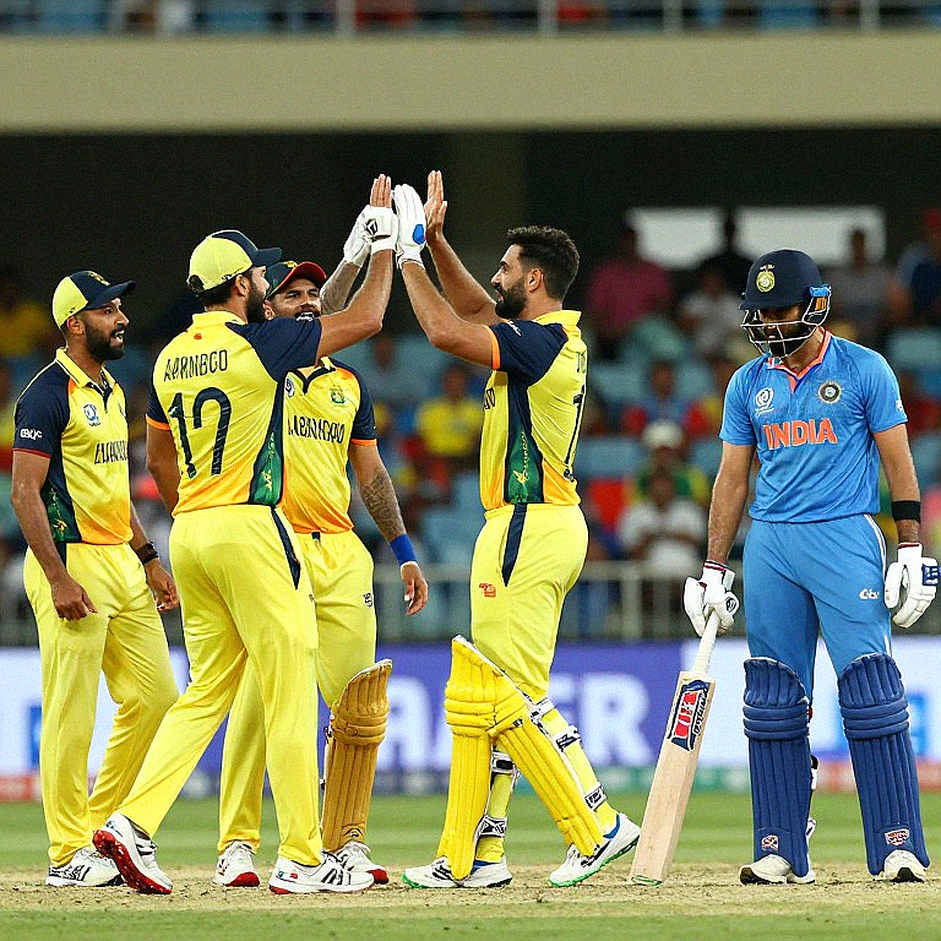
Read conventionally, this is a 177. Read as a ledger, it is two different innings stapled to one page. First innings: 68 balls, 66 runs, five wickets. Second innings: 51 balls, 111 runs, five wickets — a strike rate of 217.6. That is the version of cricket franchise scouts clip and coaches cannot ask anyone to repeat at training the next morning.
Three batters made 128 of the 177 — Ahmadzai 52, Shahidullah 46, Rashid Khan 30 — roughly 72 per cent of the total. Concentration that high inside one innings is an outlier, not a template.
Ahmadzai in numbers: 52 off 22, strike rate 236.4, four sixes and four fours. Forty of his 52 came in boundaries, a boundary share of 76.9 per cent, one every 2.75 balls. A finisher's normal band sits around 55 to 70 per cent. He was above it.
Here is the line that matters, though: 22 balls is a sentence, not a sample. I have watched plenty of 20-ball innings go viral in the evening and vanish from scout shortlists inside six months. A 236 strike rate is a match-winning cameo; it is not proof that Afghanistan has found a finisher.
And the scorecard says something quietly: Ahmadzai arrived at No.7 at 66/5. In this XI's construction he was not trusted as a top-six option. Promoting him on one innings is the oldest selection error in T20 cricket — and the exact error that gets repackaged as an all-rounder premium at an auction.
The all-rounder tag deserves the same scrutiny. Afghanistan's wicket-takers read Farooqi three, Omarzai two, Mujeeb two, Rashid two, Shahidullah one. Ahmadzai is nowhere on the list. Either he did not bowl or he bowled without return. His dual value rests on outside reputation, not on anything this fixture proved.
Now Shahidullah, 46 off 42, a strike rate of 109.5. On a card it looks slow, because a No.6 anchor is expected to sit in the 125-140 band. But he arrived at 66/5. At that moment 109 was not slowness, it was a condition — the condition on which Ahmadzai and Rashid were allowed to play at 13 an over.
Both things are true at once. His occupation kept the innings from collapsing to 130, and his 109 is also why Afghanistan finished at 177 rather than 195. In the 57-run sixth-wicket stand, the bulk of the strike belonged to Ahmadzai; the partnership was less a partnership than one-directional strike management.
Rashid's 30 off 10, with a 93 per cent boundary share, is not new information, but it carries a new obligation. He is now three roles at once — captain, frontline spinner, lower-order enforcer. A strength for the team, an accumulating workload for the individual.
In the bowling column the cleanest number is Fazalhaq Farooqi's: 3.1 overs, 13 runs, three wickets. Economy 4.11, a wicket every 6.33 balls. On a ground built for batters, that was the quietest decisive performance of the night.
There is a detail buried in the 3.1: he bowled the 115th ball of the innings. A left-arm quick with new-ball swing was deployed as the closing enforcer rather than a four-over-through specialist. Worth noting, because in world T20 a left-armer who can swing it new and land a yorker is the scarcest profile in the market.
Zimbabwe's best bowler, Newman Nyamhuri, took 4/31 in 3.5 overs at 8.09 an over. Four wickets is the headline; 31 runs is the underlying truth. Those wickets came from Afghanistan taking risk, not from containment — a distinction that grows large when he has to defend rather than attack.
And here is the number I want recorded: eight of Afghanistan's ten wickets fell to Zimbabwe's seamers (Nyamhuri four, Evans two, Masuku two); the spinners took two (Masakadza, Raza). On a Sharjah surface where spin is supposed to control the game, that is inverted. The scoreline says 177; the wicket distribution says Zimbabwe's pace attack is being under-credited on this tour.
Chasing 178, Zimbabwe needed 8.90 an over. They batted at 7.30 and were bowled out in 19.1 overs with five balls unused. The top score was Ryan Burl's 32 off 24 at 133.3. A top score of 32 in a chase of this size is the diagnosis: innings of this scale usually need one 60-plus knock or two 45-plus ones.
Raza and Madhevere both made 17. Identical scores are coincidence; both stalling below an implied 130 strike rate is not. Two senior batters executing poorly under chase pressure is not a talent problem, it is an execution problem. Zimbabwe lost a wicket roughly every 11.5 balls. That is not rhythm, that is spill.
Now the argument worth having.
This was not a comfortable win. The 37-run margin describes the outcome; the process ran the other way for eleven overs. Anyone who files this as a 'comfortable' victory will expect the same Afghanistan top order on Thursday and be surprised. Read it the way I read a deal — not by the announcement but by the silence before it. The match did not die at the deadline; it was decided in the silence of those 11.2 overs.
Second: the toss did not backfire. Bowling first at Sharjah with dew around is a defensible call, and by 66/5 that call was winning. What failed was death-bowling execution and third-change control. Blaming the toss is mistaking outcome for process, and that habit will repeat itself at the next match.
Third, the part that irritates me most: labelling Ahmadzai an 'emerging all-rounder'. Twenty-two balls and zero bowling evidence cannot carry that label. My threshold is at least three innings with comparable intent before his role is discussed. The combination of left-arm scarcity and the auction's all-rounder premium means one 22-ball clip can sell a player above his actual value.
And what is absent from this report is also information: no ages recorded, no injury detail, no DRS controversy, no over-rate sanction. Where those are missing there is usually no story — but one absence is the story. Zimbabwe do not have a trusted death bowler, and that is the loudest thing in the scorecard.
The series structure pushes the same way. All three matches sit at one venue. Afghanistan get to reuse Sharjah's behaviour — dew timing, boundary dimensions, pitch wear — three times over. Zimbabwe get no second surface to reset on. That is not a matchup; that is architecture.
On Thursday I will watch three things, all more informative than the final score. First, Afghanistan's run rate at ten overs: below 6.5 again and 66/5 is a habit, not an accident. Second, Zimbabwe's economy from overs 16 to 20: above 11 again and the series diagnosis is complete — that number, not the margin, predicts the next two games. Third, Ahmadzai's entry point: a move up the order means selection treated a clip as evidence; staying at seven means the team management was smarter than the scorecard.
One last thing I write on the first night of every series: these figures come from a public scorecard summary while the series is live, and must be checked against a primary source before the second T20I. I do not chase leaks; I follow the paper trail. Tonight the paper trail says 66/5, not 37 runs.
The question is not whether Afghanistan win again. It is whether the seventh-wicket magic can be repeated the next time the top order is 40/3 — or whether that is the night we discover we mistook a cameo for a career.